I have heard of the scorching suns of Turkana, but never experienced them. The word suns is intentional, because it feels like multiple suns burning at once. That is how hot it was when I decided to set off and tell stories of water in Turkana County. I arrived early in the morning from Nairobi. It was a bit chilly, but I did not expect a day full of intense heat.

By 9 a.m., I was in Kalokol, a water community one hour away from Lodwar Town in Turkana County, and the heat was already picking up steam. It felt like it was already 12 p.m. It is the dry shrubs and white sands that alert you to the lack of water, but still, I was met by several water sellers on bodas (motorbikes) and tuk-tuks. They bring water from the nearest laga and sell it to the town centre. If your family can afford it, they will deliver it to your home at KES 15 or KES 20 per jerrycan when the situation is dire. The water sellers are mostly men.
For a moment, I was relieved that these women were spared from the burden of fetching water. However, my excitement did not last long. I was also met by women of all ages and children rolling jerrycans on the ground in search of a pail of water for domestic use at home.

Northern Kenya is a large section of the country that most people do not find time to talk about. We do not talk about it because we do not know much about it, just like the rest of the world. We are only shocked when we see people dying of famine or trekking miles and miles just to get a pail of water.

No one really says much about it, hoping the government is doing something. Sometimes, while scrolling on social media, you are met with these painful realities, and you find yourself detached from them, mostly because they are too painful, but also because you are aware you may never meet these people in person, making it hard to relate. Or perhaps it is simply due to arrogance, lack of empathy, and lack of compassion. All in all, most people act as if Northern Kenya does not exist, and if they do acknowledge it, the problems seem beyond us. So who will be held responsible?
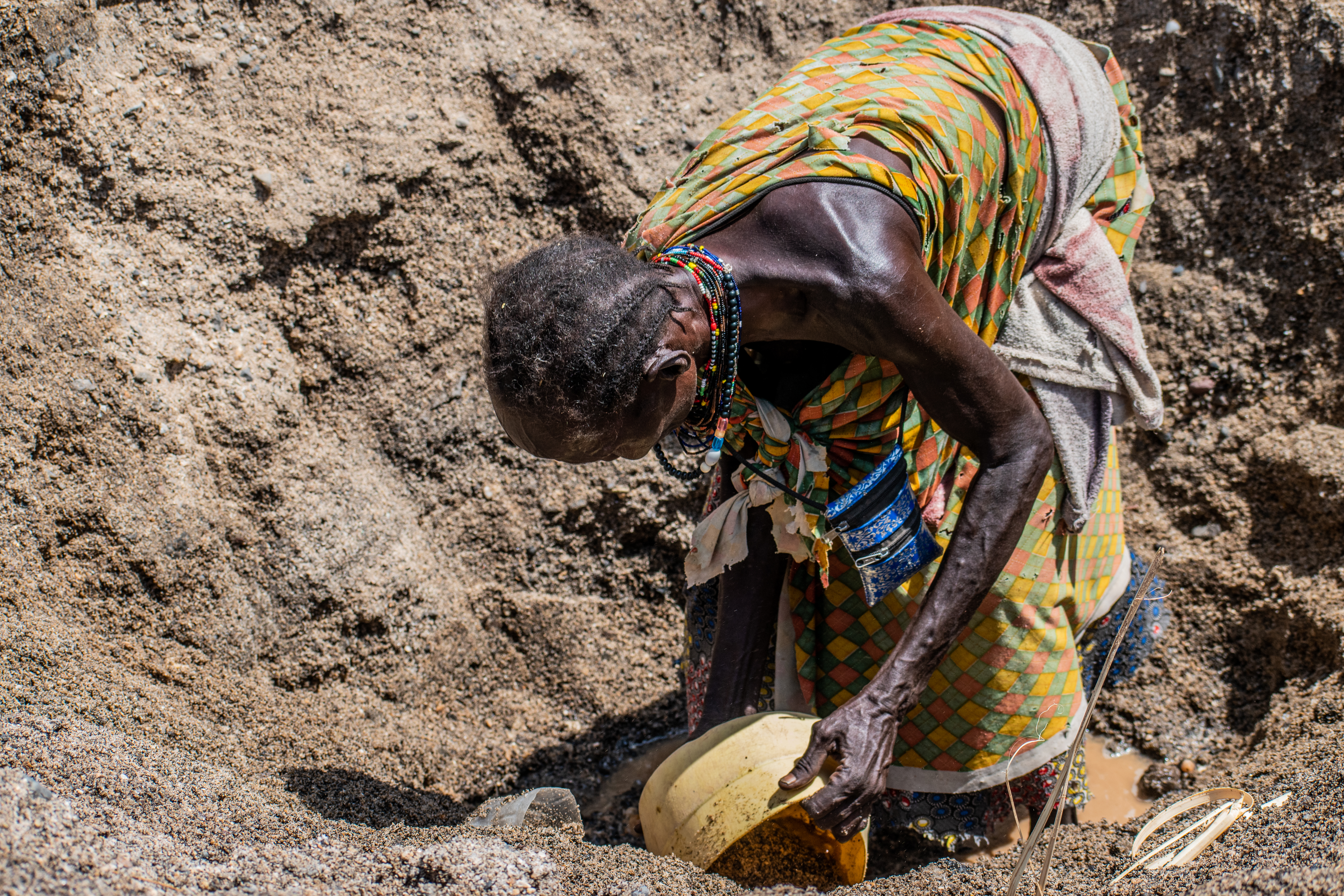
These are the thoughts troubling my mind as we approach a water point, the first of its kind in Kalokol. It is pumped water that comes through a pipe, drawn from another laga dug deep into the Napasinyang River. A laga is water collected from a dry riverbed, normally dug until water surfaces beneath the sand.
How did they know there was water at that particular point and not along the entire riverbed? I was told this is a skill embedded among the ancients in the community. They have keen Indigenous knowledge that has been sharpened over time to detect water flowing underneath dried seasonal rivers.
Here, there are many people fetching water, but most of them are water sellers, and most of them are men. I am quite impressed because, even though the distance is long, at least the water is there, and it appears clean.
As I venture deeper into where the water comes from, I am met with a large dry deserted field. This is the Napasinyang River. It carries water when it rains but runs dry when the rains take too long to arrive. The last time it rained was August 2025.

The area around the river has green shrubs and makoma trees, also known as doum fruit trees, and you can tell their roots run deep to access water flowing underneath because they remain green against the parched sandy field beneath the scorching sun.

I am overcome by emotion because it has been years since I last saw a makoma fruit. Back when I was a child living in Mombasa, I used to spot a few, and they were more succulent than these ones. These ones have a drier and tougher skin. To get to the edible part, a stone is used to scrape the hard covering.

From a distance, I spot a few people with jerricans, so I feel obliged to go there. There is no pumped water, but there is another laga. Being a Tuesday morning, a school day, I am surprised at the number of children lined up to fetch water.

Around the laga is a woman adorned in a beautiful Turkana neckpiece. She immediately catches my attention. She has stopped to quench her thirst and explains that she left home at 5 a.m., and it has taken her almost five hours to reach this water point. She is now on her way to sell charcoal. She says she burns dead trees that can no longer revive even when it rains and sells the charcoal to feed her family. She is graceful, and from her eyes, you cannot tell how tired she is.

Kennedy, my local guide, points to a ring slightly bigger than the rest of the beaded ornaments covering her neck and mentions that it is actually her wedding ring. She has never taken it off. It is part of her, and according to Turkana culture, that ring can bring calamity to the home if a woman strays from her marriage. The husband will know immediately because misfortune after misfortune will befall the homestead. Interesting.

I wondered whether this was true, but she seemed to wear it with pride. It speaks to how rich cultures and beliefs still thrive in this technology-driven economy. She drinks deeply from a jug of water and takes a few makoma fruits that Ken had asked some children to fetch a few metres away from the laga. Then she sets off to sell her charcoal in the centre. Her colourful attire flowing behind her almost makes you forget the children’s laughter surrounding the water point as they happily chase one another.

Irene, while eating a makoma fruit, shares that she has a child and is also a married woman. Her child is 2 years old. Her husband can barely afford to put food on the table, so the burden of fetching water is left to her, and she still has to do domestic chores and take care of their child, though her husband watches over the child when she is out fetching water.
Irene left school in Form 2. She was just two years away from completing secondary school, which could have gotten her into college or university, but she dropped out. She says the situation became too difficult for her, and a few years later she got married.

“My home is approximately 5 to 6 kilometres from here, and a round trip takes me up to 4 hours. I do this in the morning and evening when the sun is mild, and sometimes when I need a lot of water to wash and clean, I do afternoons like today,” says Irene, smiling as she speaks. Irene says sometimes she spends a whole day just fetching water.
“In my community, we can be generous with anything but not water. Everyone understands the pain of getting water, and a neighbour cannot lend you even a cup of water, it is impossible,” adds Irene, as the other children nod in agreement.
Being a school day and seeing the children out here, I am convinced to ask whether they are on school break, but I am given the most heartbreaking answer: they do not go to school. One of the older girls, who looks about 10 years old, dropped out in Grade 3 because her aunt said so, and the rest of the children, all seemingly below 9 years old, along with a younger brother who appears to be around 3 years old, never started school. They do not even know how old they are.

They understand a bit of Swahili, but they are more familiar with the Turkana dialect. Since Irene is with us, she helps translate.
The older girl has 40 litres to pull and a 10-litre jerrican to push with her feet, just like Irene. The other children each have 20 litres, so I offer to help her ease the burden. I thought it would be easy. So we set off from the laga and started the journey home.


A two-hour journey in the scorching sun and seething wind
The sun is hot, the wind is blowing, and the sand is blazing hot. One of the children with us is barefoot. I am shocked by her tenacity. This is not something you get used to.

The journey is full of laughter, singing, stories, and eating the last of the makoma fruits. Ken will meet me later when I reach Irene’s house.
The jerrican is not too heavy for me to pull. The rope apparently makes it easier to pull, and the cut jerrican cover makes it easier to roll on the unforgiving hot sand. Once in a while, the rope breaks. I have not mastered the art of pulling it in a straight line like the rest.

“We do get sick a lot from this journey. The weight of it is heavy cumulatively. I already have asthma from this activity, and just the other day I was in the hospital for another attack.”
Says Irene.
The other children join in to explain just how unforgiving these winds are. It may seem scorching hot, but the wind settles into the chest like a cold. They mention that whenever they reach home and rest, that is when their bodies begin aching, especially their chests. They have no choice in the matter. Even with tired bodies and painful chests, they still wake up every day and go fetch water. It is up to them to do so.


They no longer have dreams or hopes for the future. Their hope every day is that one day it rains so they can take a small break from pulling these jerricans.
The sky is now even clearer, and the sun is almost directly above my head. It is so hot it feels like it is burning into my skull. It is now almost 2 p.m., one hour into our journey home. I ask them whether they cannot wait to get home and have some lunch.
They all turn towards me at once with blank stares, with a look that says, “What lunch?”
We decided to take a short break underneath an acacia tree. The child with bare feet climbs the tree to cool her legs, which are now burning from the heat.

“We barely have food in the morning. Lunch is definitely out of the picture, and we are lucky if we can have dinner. A number of times, after a hard day of fetching water, we go to bed hungry,” says one of the children.
“The makoma fruit we ate, sometimes it is all we have in a day, and that is why coming to get water has its perks. We get to enjoy these fruits, drink lots of water, and we are fueled enough for the next day,” affirms Irene.

They all speak these sad truths with smiles on their faces, and their resilience and bravery almost drive me to tears. I let out a sigh and put on an even braver face, but my feet are now killing me, a blister is forming, and a pounding in my head begins.
A few miles after our short break, the children are home. Two go their separate ways while another branches off a few miles later, leaving me with Irene to complete the rest of the journey, so I help her pull one jerrican.
By now, I am just holding on for dear life, so I ask how much is left of our journey, and Irene says we still have around 40 minutes. She still seems very strong, and with a smile that never leaves her face, she seems even stronger because she is anticipating seeing her son soon.
As we cross the tarmacked road, she points to a now-closed water kiosk. She mentions that there was a time they used to fetch water there. It was close to them, and for three whole months life felt like heaven. She did not have to spend so much time fetching water. She says this was back in 2024, and the water was being drawn from a well connected to Lake Turkana, but the waters of Lake Turkana eventually rose and submerged the well. Another one was never made, and neither have they seen water come out of the kiosk to date.

In the homestretch, we meet a boy coming from school. He mentions that he will not be attending afternoon classes because he is going to fetch water. This is also not new. Most school-going children forfeit afternoon classes due to hunger or the burden of fetching water for their families.

When we finally reach Irene’s home, I am exhausted. My legs are blistered, my head is pounding heavily, and I am hungry and thirsty. Her son is so happy to see her, and her husband steps out to say hi too. It feels like a little happy family reunion. The child has a cold, and Irene had been so worried about him. She takes him into her bosom and cuddles him. She switches into mum mode immediately. You cannot tell the journey she has just endured under the hot sun.
I bid my goodbyes.
The rising levels of Lake Turkana

Lake Turkana, like most lakes in the Eastern Africa region, has been rising since 2019 and has continued to do so. No one knows when it will end. There have been displacements around the riparian region. Most dry lands are now covered with water, and trees that once provided shade and fruit now lie dead in the middle of the salty waters of Lake Turkana. So far, the rising waters have covered a distance of over 3 km from the former shores.

Kalokol community in Turkana County faces some of the most severe impacts of climate change. One of the greatest challenges affects Lake Turkana. As a fishing community, residents are left counting their losses in terms of homes, livestock, and land as the lake continues to rise. This recording, generated from Google Earth imagery, shows the lake’s expansion since 2019.
Most people do not understand what is happening with the lake, but they can tell the seasons are no longer what they used to be. Sometimes the rains do not come as expected, or the dry seasons extend longer than they used to. The sun is hotter, and when it rains, it rains angrily.

As people from the African continent, we bear the brunt of the devastating impacts of climate change while contributing only 2–3% of total greenhouse gas emissions. Even though the United Nations has made commitments to help alleviate climate impacts among African countries, these commitments are yet to be known by communities at the grassroots level or even felt.


Northern Kenya is deeply affected by climate change
Northern Kenya is mostly arid and semi-arid, with most regions going several months without water. With climate impacts hitting these regions even harder, water becomes the rarest commodity.
“We have missed the rains for two consecutive seasons, and this is not something small, because women and children are the most affected and the most vulnerable in society during this drought, as they are forced to travel long distances looking for pasture and water, and this should be declared a national disaster by the government,” says a reporter from Mandera TV, Kenya.
Turkana Community Rely on Indigenous Skills to Adapt to Climate Change, and It Works
Indigenous and traditional knowledge systems, which have supported water management for thousands of years, are often undervalued and not integrated into formal water governance and planning processes. The 2026 UN Water Conference concept paper notes that community participation in water planning often feels superficial, limited to consultations rather than true co-creation of solutions, and these processes frequently miss the voices of the most marginalised.

Daniel, a community leader in the Kalokol community, voices his appreciation for the Turkana community. He is well-travelled and has been to different countries, including regions in Northern Africa that are drier than Turkana. He says he thanks God that even though Turkana County is dry, they still manage, and besides, they can actually predict their weather patterns. This catches me off guard.
“We can tell when we are in for a drier season, when we will get short rains, or when we shall get full rains. We do this by observing the moon,” says Daniel, speaking confidently about this Indigenous skill.
He says when the moon is in a crescent shape and facing upwards, then it means they will have rains, but when the crescent is facing down, it means there will be no rains. He also mentions that sometimes the crescent looks like a cow’s horn, and this normally means there will be no rains for a while. Daniel says this works so well, and it removes anxiety among them and instead brings gratitude because whichever season they are in or coming into, they are already warned or fully aware. He says even in the age of climate change, this skill still remains strong even after decades have passed by.

He says yes, the moon has a full monthly cycle, but there are times when they do not see the moon completely, and when they do, its crescent shape gives them more information to help them through both the dry and rainy seasons.
Across regions, including Africa, rural and Indigenous women are particularly affected by systemic barriers in access, participation, and leadership due to socio-cultural norms and legal constraints. However, evidence shows that inclusive policies and women’s participation improve water governance and sustainability.

The United Nations World Water Development Report 2026, “Water for All People — Equal Rights and Opportunities,” published by UNESCO on behalf of UN-Water and launched on World Water Day, 22 March 2026, calls for removing legal, institutional, and financial barriers and expanding gender-responsive financing and budgeting. It also emphasises investment in sex-disaggregated data, recognition of unpaid labour, and strengthening women’s leadership and technical capacity.
The County Government Speaks
Turkana County says it has made climate resilience a priority, backed by the Turkana Climate Change Act of 2021, which requires at least 2% of the county’s annual development budget to be allocated to climate action. The county has committed KES 120 million annually towards climate interventions, a contribution that has also unlocked additional support from the World Bank to strengthen community resilience.

According to Thomas Kiyong’a, Deputy Director in Charge of Climate Change under the Ministry of Natural Resources and Environment, Turkana County Government, climate adaptation works best when local communities are part of the solution. He says the county has strengthened its climate response by combining indigenous knowledge with scientific forecasting to better prepare communities for extreme weather events.
Some of the indigenous methods the community uses include, but are not limited to, observing the moon, monitoring the behaviour of trees, tracking the migration patterns of birds, and examining the intestines of goats and sheep to predict weather patterns.
“These things work. This is knowledge that has sustained these communities for a very long time, even before modern science,” says Thomas. “When we conduct participatory scenario planning, the information we get from local seers is often in tandem with what the Kenya Meteorological Department projects. When we blend the two, it gives communities more trust because they see their own knowledge reflected in the information we are sharing.”
Kiyong’a shares that the county is also investing in long-term resilience by strengthening early warning systems, solarizing boreholes, rehabilitating water infrastructure, and supporting climate adaptation projects identified by local communities themselves. He says the goal is to ensure that both modern innovation and indigenous wisdom help vulnerable communities navigate an increasingly unpredictable climate.

As climate impacts intensify, particularly along the shores of Lake Turkana, the county is investing in practical solutions. These include drilling and solarizing boreholes, rehabilitating water infrastructure, supporting irrigation and farming, and extending water access to pastoral communities. The government says these efforts are aimed at rebuilding livelihoods and helping vulnerable communities adapt to a changing climate.


Leave a Reply