Atop a hill, a very high hill, along a narrow path almost 30 km from Kendu Bay town, lies Ahango Sunrise, officially known as Ahango Early Childhood Education, a name it has borne since its inception when the community came together to start a school that could serve community members, as other schools were quite far from this hilltop community.

Ahango ECDE is in Ahango Kobuya East Sublocation, Kobuya Location, Wang’ Chieng’ Ward, Rachuonyo North, in Homa Bay County.
Ahango community is a community that defines resilience, a community that has gone through a lot and refuses to back down.
“In Ahango, we have no infrastructure, we have no electricity, only a few households have solar energy, and worse still, we have no water and no health facility nearby,” says Ahango Headteacher, Mr Charles Omondi, who has been with the school for five years.

Ahango is a very tight-knit community. Everyone knows everyone, and kindness is what runs this community, alongside a love that ensures each and every person is taken care of.
Charles shares that Ahango hosts 150 children in total, ranging from early childhood education to Grade 6. The children transfer to other schools for their junior education thereafter.

“If we have sufficient classes one day, we shall have learners finish their primary education within Ahango. Our students are very bright, and they excel outside this institution,” says Charles, looking outside the small window as the children’s laughter and screams fill the air.
Ahango is a private school and relies on fees paid by the children’s families to manage operations. The classrooms are not in the best shape, with the best classrooms being the former Ahango Church building and the current church building, both used to host classes.
On this particular day, there were only a few children around, as most had been sent back home to fetch school fees.

No matter, this does not stop the jubilant screams of the remaining children as they run around after finishing their meal of porridge and githeri (beans and maize cooked together and seasoned with salt).
Two young sisters, one in PP2 and the other in Grade 2, play alongside another girl. The game is called amiso in Luo, where they play with a small ball. It takes three girls, with one standing at the centre trying to avoid being hit by the ball as it is thrown between the other two. If the ball hits you, someone else enters the centre.

Nicole and Josephine share a strong bond, the bond of sisters. Their mother is also a teacher at the school. They like playing together, and no one can deny the strength of their sisterhood. Soon, they begin another game as soon as they get bored. This game is called rock, paper, scissors. If both make the same shape, it is a tie; a different shape determines a winner.

Children are always active, and after running around, chasing each other in the dirt and playing all sorts of games, it is time to rest and recharge before heading out for afternoon classes.

They run to the back, and here lies the school’s source of life: water.
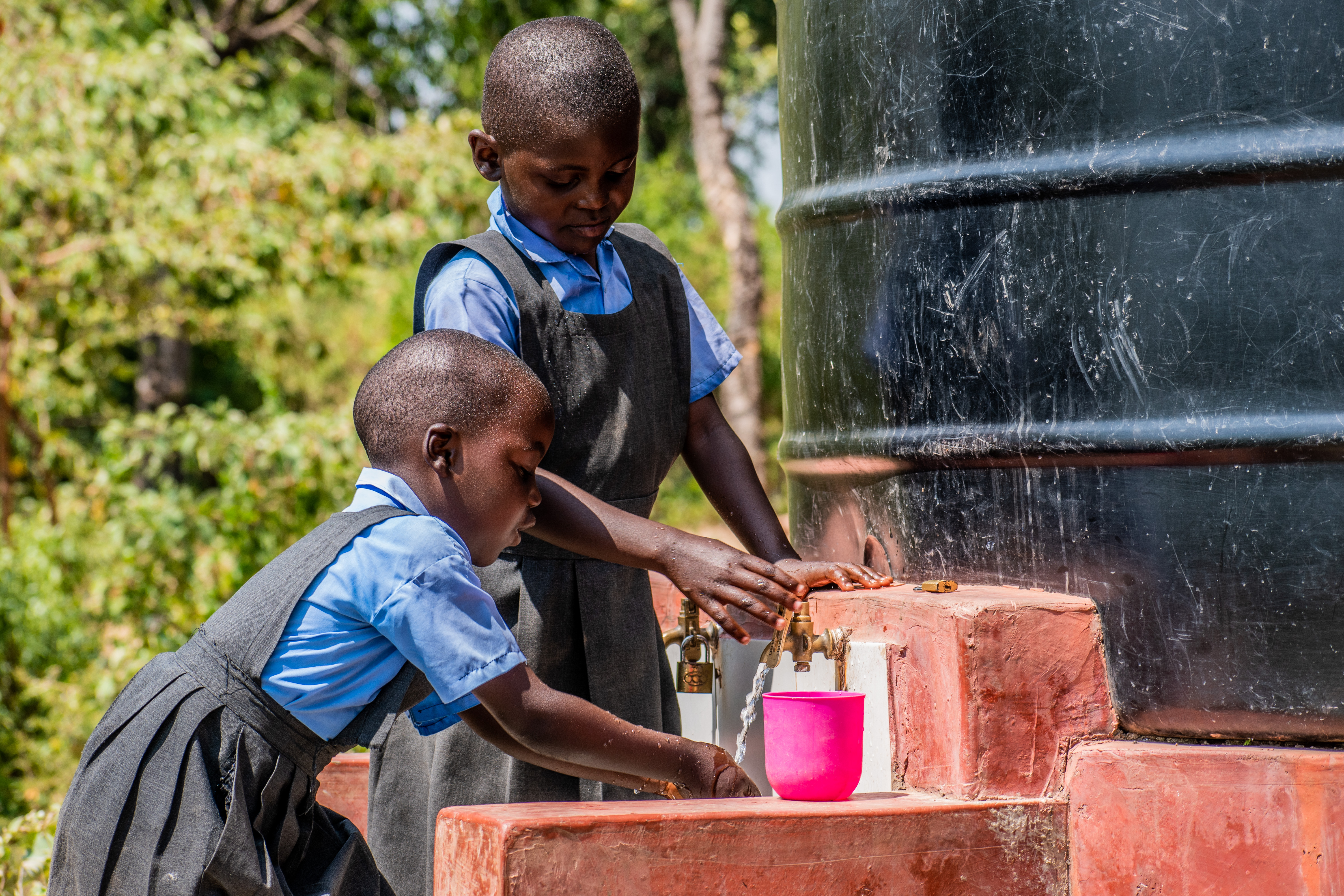
Nicole and Josephine get there first. They open the taps, and water begins to flow from the gigantic water tank positioned right behind the new church building, which also serves as classrooms.
They begin by washing their hands as the water flows, and then they grab a cup and take their fill to quench their thirst.

It has not rained for two months. The sun is harsh and the dust unforgiving, so their dusty hands are cleaned and their thirst quenched. There is laughter all around the water tank. It is their happy place.
Once they are done, they run back to the classroom. The teacher says they will be released early as they are quite few.
“These children used to fetch water from the Sondu Miriu River. It is a river 5 km from here, and they would climb a hill carrying water back to school for use. The other option is a stagnant water pan 3 km from here, and it is not safe for drinking,” says Michael, pointing at the tank.

Michael says the tank was donated by the Safaricom M-PESA Foundation, and since then, life has changed drastically. The children have been spared the burden of fetching water across long distances, especially during the dry seasons. Being a school, sanitation is key to keeping the community healthy, so the water helps bridge this gap. It is also their only source of water for cooking and drinking.

“We received a 20,000-litre tank. It serves not only the school but also the community. Many people come to get drinking water from this tank, so it is a lifeline for the entire community,” says Charles proudly, with a smile on his face.

The Ahango community, 14 years after establishing Ahango ECDE, still wishes for better classrooms, better infrastructure, a nearby health centre, electricity, and more resources to support the learners. But they have life, and water is their greatest source of life. It lies right there on the hill with them for daily use, and they say it remains one of their greatest gifts since inception.


Leave a Reply